Tuesday, 1 April 2014

Israel's ex-PM Ehud Olmert convicted of bribery

Ehud Olmert (file photo)

Israel's former Prime Minister Ehud Olmert, who resigned from office in 2008 amid a corruption inquiry, has been found guilty in a bribery trial.
Olmert was convicted in what is known as the "Holyland affair" in which bribes were paid to speed up a luxury property development in Jerusalem.
He has already been cleared in several other corruption trials.
The 68-year-old former Kadima party leader had denied wrongdoing and had hinted at a political comeback.
The offences happened when Olmert was mayor of Jerusalem and subsequently a government minister.
Delivering the verdict in Tel Aviv on Monday, Judge David Rozen said the case "exposed governance that grew more corrupt and rotten over the years, with bribes paid to public officials," the Associated Press news agency reported.
Olmert succeeded Ariel Sharon as Prime Minister after the latter had a stroke in January 2006. He was mayor of Jerusalem from 1993 to 2003.
In 2012 Olmert was cleared of two major corruption charges but convicted of illegally granting favours to a business friend during his time as trade and industry minister under Mr Sharon.
He was fined $19,000 and given a one-year suspended jail sentence.
The Holyland affair saw millions of dollars in bribes change hands in one of the biggest corruption scandals in Israel's history.
As prime minister, Olmert pursued peace talks with the Palestinians and made an extensive offer of land-for-peace in 2008. He also oversaw the 2006 war with Hezbollah in Lebanon but subsequently struggled with low approval ratings.

Iran steals $17 billion worth of Iraqi oil annually claims report

Published On: Mon, Mar 31st, 2014
Iraq-Oil-Pipeline-e1375973654735
 
Iran steals $17 billion worth of Iraqi oil annually claims report
 
According to the report, Iran steals $17 billion worth of Iraqi oil from fields that are mostly Iraqi and not shared between the two countries. Those fields are home to more than 100 billion barrels and the majority of them are inside the borders of Iraq.
The amount of oil Iran takes from Iraq, the report explained, is estimated at 130,000 barrels and mainly comes from four Iraqi fields: Dehloran, Naft Shahr, Beidar West, and Aban. Iran’s violation of Iraqi oil rights also extends to the fields of al-Tayeb and Fakka as well as parts of Majnoun field with an estimated 250,000 barrels.
The total amount of oil Iran steals from Iraq is estimated at 14 percent of Iraqi oil revenue.
The report points out that Iran is using Iraqi oil unilaterally even though the two countries have previously agreed on forming joint committees to regulate the use of oil in border fields. In addition, excavation activities Iran carries out on the border have a negative impact on the quality of Iraqi oil since it affects the pressure in Iraqi fields.
According to the report, the transfer of Iraqi oil to Iran is made possible through smuggling networks spread across the borders that take to Iran an average of 35,000 barrels a day.
The smuggling of Iraqi oil to Iran plays a major role in abating the effect of the economic sanctions imposed on Iran. The stolen oil is later re-exported to Iraq after being manufactured into a variety of oil products or into electric power.
Such export deals are done under the agreement Iraq signed with Iran and which enables the first to import four million barrels of fuel daily from the second in order to make up for shortage of energy. Meanwhile, Iran’s daily production of fuel has increased by 20 million liters in 2012.
The report pointed out that the Iraqi Ministry of Petroleum has not been diligent enough to install electronic meters that would detect the amounts of extracted and transferred oil. The ministry also refused applying the satellite vigilance system that monitors the in and out of oil.
The report described the Iraqi government’s attitude as “surprising” since it is too lenient with Iran while it imposes a lot of restrictions on its oil partners inside Iraq.
For example, the Iraqi central government is boycotting companies that signed oil contracts with the autonomous region of Kurdistan despite the negative impact this is bound to have on the Iraqi national economy.
The Iraqi economy is also expected to suffer another blow, the report stated, after the agreement that allows the Syrian Oil Company to carry out excavation operations in southern Iraq despite the sanctions imposed on the Syrian regime and the possibility of similar sanctions on Iraq following this agreement.
In the report, the International Centre for Development Studies called upon the Iraqi government to demarcate the borders of its oil fields and to develop local oil manufacturing facilities. This, the report highlighted, is especially important now with Iran trying to sign contracts with Russian and Chinese oil companies that allow the three countries to use Iraqi oil fields in order to produce 5.2 million barrels daily by the year 2012.
According to the report, Iran now has the right to supervise oil production in the Yadfaran oil field in southeastern Iraq after signing a deal with the Chinese company Sinopec.
This deal will deprive Iraq of benefiting from the production of this field, home to almost 12 billion barrels of crude oil and 12.5 cubic meters of natural gas in addition to 1.9 billion barrels of oil concentrates

California man washed out to sea during baptism

A man holds his young child on a the breakwater of Santa Barbara Harbor, 1 March 2014

A California man remains missing a day after he was swept out to sea during an ocean baptism.
Benito Flores, 43, was among several people helping his cousin, Pastor Maurigro Cervantes, baptise a man near the Guadalupe Dunes Preserve north of Santa Barbara.
Two others were swept out by a huge wave but were able to swim to shore.
The US Coast Guard says the search for Mr Flores was called off at midnight on Sunday.
The baptism was just finishing up at 10:00 local time (17:00 GMT) on Sunday when the church members were hit by the wave.
"A big wave came and took Benito," Mr Cervantes told local broadcaster KEYT. "I tried to take him out, he was heavy and then another big wave came."
The US Coast Guard and as well as local rescue officials were involved in the search but there are no plans to resume it.
Santa Barbara Fire Captain David Sadecki said it would be difficult for anyone to survive more than 30 minutes in the cold water.
Mr Cervantes, who leads the Jesus Christ Light of the Sky church in Santa Maria, said his church performed such ceremonies two or three times a year, according to the Santa Maria Times.

Hidalgo's Paris win is a bright spot for socialists as UMP rides 'blue wave'

Paris Socialist Mayoral Candidate Anne Hidalgo

Hidalgo's likely triumph was a rare moment for celebration in what was a dismal evening for Hollande. Photograph: Chesnot/Getty Images
Paris looked set to elect its first female mayor on Sunday night, but the victory for socialist Anne Hidalgo was an isolated piece of good news for President François Hollande's embattled party.
The exit polls showed that Spanish-born Hidalgo, 54, was estimated to have won, with 55% of the vote, well ahead of her centre-right rival Nathalie Kosciusko-Morizet.
If her victory is confirmed in a final count Hidalgo will succeed the popular Socialist mayor Bertrand Delanoë, who has run the city since 2001. Last year she told the Guardian that running Paris was "the best elected job that exists".
But her probable triumph was a rare moment for celebration in what was a dismal evening for Hollande, whose popularity was already at rock bottom even before Sunday's vote, and his Socialist (PS) government.
Elsewhere, the Front National appeared to have once again punched above its real electoral weight in what may well turn out to have been a protest vote.
The party's charismatic president, Marine Le Pen, said the results marked a "new step for the FN" and said she hoped to translate its success into seats in the European elections in May.
"The Front National has upset the traditional UMP-PS duo. From now on they will have to count on a third great political force in our country," Le Pen said.
The revival of the FN as the Socialists struggle takes the far-right party back to levels last seen in 2002 when far-right presidential candidate Jean-Marie Le Pen knocked out the Socialist candidate in the first round of the presidential elections.
The FN took the towns of Béziers, where FN candidate Robert Ménard, former head of Reporters Sans Frontiers, obtained more than 47% of the vote, and Fréjus, but lost the symbolic city of Avignon, where the FN candidate had led the first-round vote.
Most of the FN's successes were in the east and west of the country in areas with high unemployment and immigration.
If there was any small consolation for the president and his administration, it was that while the centre-right UMP emerged overall winners, it was that the FN had not done as well as results of first-round voting last Sunday had suggested.
In the rest of the country, French voters stayed away from polling stations in record numbers for the second round of local elections.
The 38% rate of abstention in the second round of the election was seen as a direct message of disillusion with the country's ruling class, particularly the struggling Socialist government headed by Hollande.
Among the most symbolic losses for the governing Socialists were those of the town of Limoges, which the left had held since 1912, Saint Etienne, which fell to a UMP candidate, Belfort, which went to the right, and Quimper in Brittany, which elected an UMP mayor.
Najat Vallaud-Belkacem, spokesperson for the government, was the first to admit: "The results are bad. We hear the message that has been sent."
Jean-Francois Copé of the centre-right UMP said the local elections were an overwhelming success for his opposition party. "It's a blue wave … the first major victory for the UP in a local election,' he said.
There were fears that the high level of abstentions among voters would play in favour of the FN. However, the first estimates showed an increase in support for the mainstream right opposition UMP party, while support for the far-right, which has undoubtedly increased, was not as great as had been suggested by the first-round vote.
Local elections are traditionally seen as a way for the electorate to express their dissatisfaction with the government of the day.
Around 30,000 of the 36,000 municipalities in France had already elected their mayors in the first round. This included one FN mayor elected outright. Only in areas where no party obtained more than 50% of the vote did the election go to a second round.
However, in those 6,000 areas, the FN has a strong showing, particularly in the south of France. In Avignon, one of the towns in which the FN led after the first round, the Socialist party candidate won the seat.
The abstention level in the first round last Sunday was 36.45%, already high and an indication of voter disaffection with the mainstream political parties ahead of this weekend's poll.
Nonna Mayer, research director at the Centre of European Studies at Sciences Po, said: "They can't be stopped. It's the first time the Front National has organised such an electoral dynamic in local elections.
Mayer said the FN was benefiting from a "give them a go" attitude in France. She added: "Voters are so tired of the economic situation and they have the feeling that the left and the right have been unable to find a solution … they say we have tried everything, why not try the Front National."
First estimates suggested 49% of voters had supported centre right UMP candidates, 42% Socialist party candidates, and 9% the Front National, a substantial increase in support for the far-right.
Ségolène Royal, a former presidential candidate, said the results were a "severe warning" for the government.
"It's the party system that has been punished," she said. "There are a number of French people who have had enough of the system. They want democracy.
"The French have not seen the results of the efforts we have demanded of them."
She added: "I hope this defeat will awaken the team in power."
French finance minister Pierre Moscovici admitted: "It's difficult to reform a country like France. This is undoubtedly a defeat for us."

Albuquerque protests over New Mexico police shootings

Protesters hold a rally in front of the University of New Mexico in Albuquerque against recent police shootings on 30 March 2014

Protesters have confronted riot officers in Albuquerque during a march against police shootings.
Police fired tear gas at demonstrators and made several arrests following unrest in the centre of the New Mexico city, according to local media reports.
It comes after a video emerged of police shooting dead a homeless man named as James Boyd.
It was filmed by the police using cameras and posted online following a public information request.
Standoff
Meanwhile Albuquerque police said their website had been temporarily brought down on Sunday because of a cyber-attack.
The hacking collective Anonymous had warned of retaliation over the James Boyd shooting.
He was killed in the foothills of the Sandia Mountains on the east side of Albuquerque following a stand-off.
Last week, Albuquerque police fatally shot another man, identified as Alfred Redwine, at a housing estate.
A protester faces off with an Albuquerque officer during a rally against recent police shootings in Albuquerque on Sunday 30 March 2014 Protesters faced off with riot officers in the streets of Albuquerque
Protesters hold a sit-in in downtown Albuquerque during a rally against recent police shootings on 30 March 2014 Anger has built following two fatal police shootings this month
The department has been involved in 37 shootings, 24 of them fatal, since 2010, according to the Albuquerque Journal.
Critics say it is far too many for a department serving a city of about 555,000.
Hundreds of protesters took to the streets on Sunday afternoon and demonstrations continued into the early evening, according to the Associated Press.
Mayor Richard Berry was quoted by the Albuquerque Journal saying stones were thrown at officers.
The US Justice Department has been investigating the Albuquerque Police Department for more than a year, looking into complaints of civil rights violations and allegations of excessive use of force.
The FBI has opened an investigation into the shooting of James Boyd on 16 March.

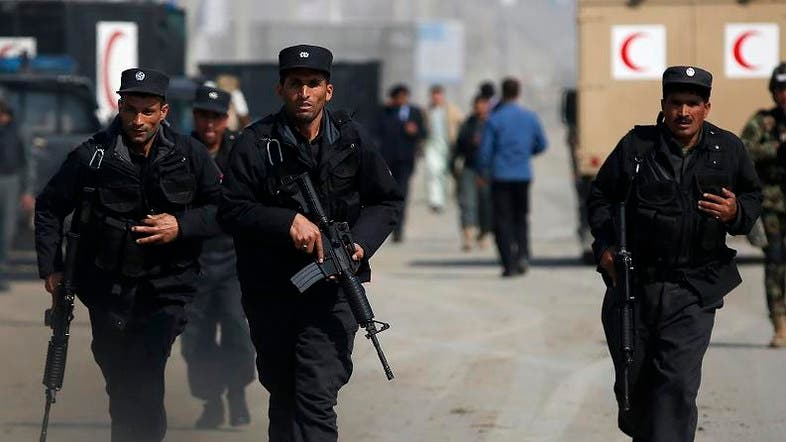
Taliban kidnap Afghan provincial election candidate

Taliban kidnap Afghan provincial election candidate

Afghan security forces said they had launched an operation to find the group. (File photo: Reuters)
  
   
Taliban gunmen abducted a provincial election candidate in northern Afghanistan, officials said on Monday, five days ahead of national polls the Islamist militants have vowed to target.

Afghanistan will vote on Saturday to choose a successor to President Hamid Karzai and to decide the make-up of 34 provincial councils in elections seen as a benchmark of progress since the Taliban were ousted from power in 2001.

Abdul Jabar Haqbeen, governor of Sari Pul province, told AFP that Hussain Nazari and six supporters were kidnapped on Sunday evening.

"They were on their way from Sancharak district to the provincial capital of Sari Pul when they faced a Taliban ambush," he said.

The group, who did not have any security protection, were returning after campaigning when they were dragged from their taxi at gunpoint.

Afghan security forces said they had launched an operation to find the group.

A roadside bomb in Kunduz also killed five bodyguards protecting a local militia commander on Monday.

The latest violence comes after several high-profile attacks in Kabul in the run-up to polling day.

On Saturday, the Kabul headquarters of the Independent Election Commission (IEC) was attacked when five Taliban militants occupied a nearby building and unleashed rockets and gunfire at the fortified compound.

All five attackers were killed by Afghan security forces six hours after the attack began, and there were no other casualties.

Another IEC centre, Kabul's most prestigious hotel and a guesthouse run by a US anti-landmine charity have also been targeted in recent weeks.

'Obamacare' enrolment deadline looms as interest spikes

People wait in line at a health insurance enrolment event in Cudahy, California 27 March 2014

Americans are rushing to sign up for health insurance under President Barack Obama's signature healthcare programme, as a key enrolment deadline looms.
Monday is the last day for most Americans to sign up for coverage or face a penalty next year.
More than six million have signed up for plans through the Affordable Care Act's insurance marketplaces.
But conservatives are expected to tap into discontent with the law in November's midterm elections.
The elections will determine the shape of Congress for Mr Obama's last two years in office.
'Software bug'
The federally run health insurance marketplace website healthcare.gov, which saw major technical glitches during its rollout in October, was briefly out of service for several hours on Monday morning.
Visitors were advised the site was down for maintenance or directed to a virtual waiting room.
Spokesman Aaron Albright said routine nightly maintenance was extended on Monday because of a "technical problem".
The Department of Health and Human Services called it "a software bug" unrelated to the rush of applications.
The 2010 law, known as the Patient Protection and Affordable Care Act, is intended to extend health insurance to the roughly 48 million Americans who do not receive it through their employers, the government, or a privately purchased plan.
The law also aims to slow the growth in the cost of healthcare through various measures and requires private plans to meet a certain level of coverage.
The health law has been vigorously opposed by the Republican Party and by conservatives in the private sector who see it as an inappropriate government intrusion into the massive healthcare industry and an affront to personal liberty.
The law also remains controversial among the American public, as some people have seen their insurance costs rise or their old plans cancelled, and others object to having to purchase insurance at all.
Healthcare.gov and similar marketplace websites run by some states are a key element of the Affordable Care Act, providing a clearinghouse for people to purchase health insurance for themselves and their families, often with generous subsidies.
Those who are not covered by private insurance or government programmes by the end of Monday will face a tax penalty, although the Obama administration has extended a grace period for those who can prove they have had technical issues with the site.